Sunday, December 22, 2024

stonewalling

 The degree of civilization in a society can be judged by entering its prisons 
~ Dostoyevsky, The House of the Dead
Lady of Shalott, William Holman Hunt

Stonewalling is the act of shutting a person out using physical separation, verbal silence or emotional disengagemnt. As the name implies, it is a defense used to put an unwanted person or situation on the other side of an impassable wall. It is a primitive practice and was used in ancient Greece to collectively reject a socially dangerous person by voting with bits of shard (or ostraka, origin of the word ostracism) to elect the outcast, and goes back at least as far as the ancient Jewish practice of scapegoating if not earlier; to the casting out of Ishmael and Hagar in the desert (Genesis 21:14).

In intimate relationships, stonewalling is used (85% of the time by men) to separate the stonewaller from his partner, usually in a situation of heightened emotional reactivity or conflict. The stonewaller typically justifies his behaviour as a response to feeling overwhelmed. Flooded with negative emotional energy (frustration, anger, jealousy, resentment, guilt or shame), the intention is to avoid fruther escalation and to "cool down". Unfortunately, this is usually achieved only for the one who leaves the situation whereas the deserted partner's feelings further escalate into frustration, powerlessness, hopelessness, rage and despair. 

Although the stonewaller may be genuinely unaware of the deleterious effect of his behaviour on his partner, he might be using stonewalling as a strategy to get his partner to stop talking or behave in a different way; or he might be deliberately avoiding his partner and escaping accountability for his behaviour in order to pursue an addiction, affair or other guilty pleasure that excludes her. He might also be deliberately punishing and manipulating his partner in order to gain control over her or dictate the terms of their relationship*. 

Stonewalling induces very high levels of anxiety in the abandoned partner whose agency in the relationship has been singlehandedly euthanased by the stonewaller. She naturally feels insignificant and devalued from the loss of freedom and dignity in the forced separation which often leads to depression, anxiety, despair and insomnia until the stonewalling ends, also a unilateral decision of the stonewaller. 

Stonewalling 23 out of 24 hours a day for a long period of time is called, in prisons, solitary confinement of which Charles Dickens has aptly written:
...very few men are capable of estimating the immense amount of torture and agony of this dreadful punishment (...) which no man has a right to inflict upon his fellow creature. I hold this slow and daily tampering with the mysteries of the brain to be immeasurably worse than any torture of the body; and because its ghastly signs and tokens are not so palpable to the eye and sense of touch as scars upon the flesh; because its wounds are not upon the surface, and it extorts few cries that human ears can hear; therefore the more I denounce it, as a secret punishment which slumbering humanity is not roused up to stay.(Philadelphia, and its Solitary Prison, Charles Dickens, 1842)

It is no wonder John Gottman includes stonewalling in what he calls the "Four Horsemen" predicting divorce.

While conflict and emotional flooding should be de-escalated as rapidly as possible, and taking space is one good way of doing that, in order to preserve the relationship it needs to be done with civility, kindness and even compassion. It is unncessary to be rude, abrupt or unkind, or to prolong the agony by inflicting a long separation which is a cruel and avoidable punishment.

If emotional flooding makes it so that you are unable to stay present to your partner during a conversation or argument, simply tell them that you need to take a break. Tell them how much time you need and check in when that time has elapsed. If you need more time, say that but stay in touch and return as soon as possible. This is called being caring and accountable. It is not necessary to delve into a matter which may be triggering for you. But you may find that, after a break, you are able to hear your partner and mirror back what you hear without arguing. You can respond or not, as you choose. This works very well to defuse conflict. You can also postpone hearing out your partner on a topic that is difficult for you, but not indefinitely without your partner's agreement, as this would introduce another form of unilateral control over your partner and the relationship. Instead, mutually agree upon when and how to address hard topics. 

There are many tools out there: I-statements, expressing needs, nonviolent communication, etc. It doesn't have to be complicated. Look it up on the net or ask advice from a certified couple/family therapist or other specialist trained in conflict resolution. There are many helpful tweaks that can smooth out tough conversations but there is not one good reason to stonewall.

* This is a more perverse form of stonewalling characteristic of narcissistically abusive relationships. A partner who is repeatedly abused in this way ends up walking on eggshells or fawning to avoid the dreaded punishment and, once the stonewalling is over, might compulsively proffer sex, apologies or forgiveness as a way to appease the abuser in a desperate bid for reconciliation, affection or emotional reconnection. This kind of behaviour is of course the tragic hallmark of a traumatically bonded partner.


Saturday, August 31, 2024

communication, and how

 ~ the truth shall set you free (Jesus)


One of the most misleading bits of advice I've heard is that frequent, open, honest communication makes a couple stronger. Nothing could be farther from the truth. Too much communication can drive couples apart, and the wrong kind of communication can destroy them altogether (c.f. John Gottman's "Four Horsemen").

It is important to distinguish the types of communication we are using and to know their likely result when undertaking an important and potentially divisive conversation with a friend or partner. 

Aside from fact-sharing, which is a relatively benign form of communication*, there are two main styles of communication that can lead to very different outcomes: adversarial and collaborative. 

Among the adversarial styles are debate and argument. 

In a debate, each speaker represents a side or position and attempts to systematically submit facts, logic and evidence in support of it. In an argument, the debate devolves into trying to dominate one's opponent by being right, sometimes invoking what is morality "right" or "wrong" while often using defensive and aggressive strategies to buttress one's position and attack another's. While a debate may be clarifying as to why one holds a certain position, it usually does nothing to influence your adversary. An argument, on the other hand, is just another word for a fight, i.e. a forceful attempt to influence an adversary. If you choose to debate or argue with your friend or partner, expect it either to reinforce two already distinct positions, or to quash one side in favour of the other which is clearly not going to win any points with the loser. More communication like this in your important relationships and they will be over all too soon.

Among the collaborative styles are discussion and self-disclosure. 

Discussion is a tame form of argument. It is an active bilateral dialogue that does not seek to win but to exchange information in order to deliberate on a subject together, peacefully. Self-disclosure, on other hand, is more of a monologue. Like a debate minus the side-taking, it is a unilateral revelation of ideas, thoughts, feelings and beliefs so another can see into my reality, my truth. Where debate uses a lot of declarative statements, self-disclosure uses primarily I-statements, a personal and intimate style of communication which seeks to be seen without trying to force someone to agree (one hokey description I have heard of this is "into-me-see": intimacy).

When difficult topics arise, rather than promoting our view with debate or argument, relying on discussion and self-disclosure will maintain and even improve connection so decisions and/or choices can be made without driving two people apart. 


*Informing and consulting are a subset of factual communication mostly used for the purpose of clarifying logistics


Sunday, June 23, 2024

a misconception about healing

progress not perfection
~anonymous


In the language of my profession we talk about healing, as though emotional wounds were like wounds of the flesh that could heal over time. While healing may occur with emotional pain, or with the memory of its sharpness which does fade over time, an emotional wound leaves a hole that time cannot refill. That is trauma.

Trauma impales the psyche irreversibly. New experiences may be overlaid and new strategies implemented to protect the wound from further re-injury or decay, but these merely mask or buttress the original trauma. What was there before the injury cannot be restored much like bone from a cavity cannot be restored by a dental filling. Once integrity is compromised, the nerve will be closer to the surface than before, making it more susceptible to being reactive in the future.

One cannot dull the nerve of trauma with numbing agents or by extracting its "root". But that would not heal the wound anyway. It would be an emotional root canal that replaces reactivity with deadness.

The word heal comes from the word haelan, to save or make whole. Time and therapy cannot, unfortunately, do that for anyone. True to the etymological origin of our profession, however, therapists can compassionately advise, guide and accompany the wounded person as their faithful attendant or therapon in the unique and creative process of their grieving and recovery.

Saturday, March 23, 2024

EMDR

Research has shown that about five hours of EMDR treatment eliminates PTSD in 84 to 100 % of civilians with a single trauma experience including rape, accident or disaster
~Francine Shapiro
EMDR works. It's fast, simple and effective, with unprecedented success in the treatment of symptoms that have been traditionally hard to treat using CBT or talk therapy, and even medication. This success has made EMDR the most frequently sought treatment by clients, and the one most routinely prescribed by doctors and psychiatrists. Once the object of scorn within the scientific community, EMDR is now so wildly popular that its success has become a double-edged sword. 

Everybody wants EMDR!

The problem is that clients seem to believe that, because their symptoms are severe or have not responded to more conventional methods of treatment, they need EMDR, as though it were a kind of magic wand for a broad range of symptoms and problems. When all else fails, try EMDR. 

I wish it were that simple. But it is not so.

First of all, EMDR is not a broad spectrum treatment. It works only when the core of the problem can be defined and targeted by the practitioner. While its use need not be limited to symptoms of a single trauma (see above quote), when the cause of symptoms is too diffuse or undefined, i.e. a traumatic childhood, relationship or another complex cause, it cannot be treated with EMDR. There may be aspects that can be targeted but the EMDR still has to focus on one particular occurence in much the same way as radiation therapy aims at one particular tumor. It would be absolutely useless, if not to say unethical, to subject a client to EMDR to rid them of the general discomfort manifesting as, say, generalized anxiety, depression, chronic pain or low self-esteem. We would need to deal with the discomfort the same way we would deal with feathers poking through a pillow, one feather at a time. Moreover, in isolating the direct cause, other interventions may be necessary along the way.

Another thing that should be clarified is the acronym EMDR which stands for Eye Movement Desensitization and Reprocesing. Though EMDR originally used eye movements to bilaterally stimulate the brain*, it was never to reach the unconscious (as in hypnotherapy). Nor is EMDR the same as tapping (EFT), mental re-programming (as in NLP) or somatic experiencing therapy 

EMDR is remarkably efficient. It is a quick fix, but it is not a panacea.

* a better acronym would be BSRT (Bilaterally Stimulated Reprocessing Therapy)

Thursday, February 22, 2024

fast thinking

For lent I gave up
~anonymous
They say to starve a fever and feed a cold, but I think we should starve any disease that wants to consume us. That includes addiction and any and all thoughts that lead to addiction. It also includes other diseases like anorexia, anxiety and OCD and all thoughts leading to them. Starve them before they starve you. 

Fast on ideas rather than things so as not to allow your own thoughts to consume you. This is after all the purpose of fasting, isn't it? Freedom, not weight loss or a buff physique*.

*The popular "intermittent fast" may actually feed addiction by indulging restrict-binge cycles that reinforce craving rather than freedom.

Sunday, February 11, 2024

I'd rather be safe


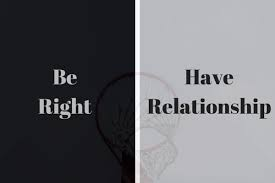
There is a saying that goes, "Either you're right or you're in a relationship." I first came across it during Imago Therapy training. My supervisor printed it on a magnet and stuck it on her filing cabinet. 

The gist of the expression, and why it is relevant to couples, is that you cannot maintain a collaborative partnership when you're both trying to be right. It is one thing to support your view with evidence or reasoned argument; quite another to argue your point by interrupting, talking over, discrediting, demeaning or devaluing your opponent... which can further devolve into name-calling, yelling, mud slinging and stonewalling. 

Trying to be right feeds a power struggle where each party wants to win and the other side has to agree, or lose. This adversarial stance is antithetical to relationship. It feeds a warmonger mindset and has no place in relationship, let alone love. I hate it very much.

Then there are those who would rather be in relationship than be right. These are the ones who can put themselves in your shoes, see where you are coming from and validate your truth even if it is different from their own. They value keeping the peace and will agree to disagree sooner than fight over who is right. These are my peeps and I love them.

BUT

While being able to acknowledge another person's perspective is a quality that peaceful society cannot live without, it can become pathological when you are dealing with someone unable to reciprocate on this level (civil) plane. 

Relationship at any cost is popularly known as codependency*. The codependent is an unwitting passenger or co-pilot on someone else's ride. Though your original intention was not to choose someone on a power trip, to remain with a person who cannot be civil to you in a reliable or consistent way is insanity.

Another expression puts it this way: "If you're on his side and he's on his side, who's on your side?" 

Though it is good to see others as legitimate and separate entities with rights equal to our own (and treat them as such), relationships become unilateral when only one person is doing all the work. In a sense, this is as antithetical to relationship as always wanting to be right. 

Though I would rather be in a relationship than be right, when being in relationship means always being wrong, I would rather be safe, unbuckle and get on another ride.

*codependency originally referred to the loving partner (parent, sibling or friend) of someone dependent on alcohol or abusing some other substance. 

Sunday, May 21, 2023

heterogamous havoc (part two)

 ~evil appears as good in the minds of those whom gods lead to destruction
(Sophocles; Antigone)


In part one of this blog post, I shared my XY theory of value differences tending to coincide with gender. I concluded that, even if there is no right way to settle value differences, there are limits as to what can be valuable to pursue.  

The "Z " value introduces those limits. It represents the inflation or deflation of values as reflected on the horizontal and vertical axes of connection and power. Z is vitality, energy and desire. It is what motivates pursuit*.

In a heterogamous world, the discrepancy between conflicting values may prompt us to restrict our pursuits to satisfy others. We might sacrifice what we value, or go for compromise rather than satisfaction. This can be all right for a short time but, if we are driven by too much obligation, it begins to drain our vital energy and replace it with the burden of responsibility. Picture a kind of inversion on the Z axis which collapses upon itself into a black hole. This is deflation, and is experienced as burnout, depression and resentment. In this phase, the strain of frustrated desire threatens to rebound into a binge.

In the binge phase, we have a diametrically opposed scenario where we overinvest our own values by accepting trade-offs with values on the opposite axis. If we value relationships, for example, we might relinquish personal power to satisfy our need for connection. If we value productivity, we might accept loss of family time to feel more productive at work. Our curve begins to bulge in the quadrant of our most cherished values. Yet the intermittent and elusive nature of satisfaction motivates us to pursue them even more. This is not sustainable. Picture an overinflated balloon. Desire runs amok and threatens to burst into the chaotic pursuit of an addiction.   

At the intersection of the three axes, right in the middle of the Z axis, is an alternative to the binge/restrict cycle of pursuit. Paradoxically, it depends on tolerating the unbridgeable gaps between different values, and accepting the unattainability of the perfection we nevertheless desire. It is at rest yet has a transcendent quality because, not satisfied by material things, it accepts that reality. Though we may still value power over connection, or vice versa, we are no longer driven by either. Nor do we succumb to impulse or obligation, but respond in every situation with deliberation and self-control. A steady state of being okay is nurtured which does not depend on anything outside of itself. That is why it is free, leaving room for peace to rush in instead of folly.

Most religions try to locate where fulfillment lies, and all concur to some degree: it is in the mysterious place where there is stillness and trust, and contentment right where we are. But this is not some esoteric concept that does not apply to real life or real life relationships. In part three I will give some practical examples of how this theory works in practice.

*Coinzidentally, the last letter of our alphabet is derived from the Greek word zeta which in turn is derived form the Hebrew word zayin, meaning weapon, or sword. Both zeta and zayin have a numerical value of 7.


Saturday, May 6, 2023

heterogamous havoc (part one)

 Would you rather be right, or in a relationship?
~ unknown

I have a working template that helps me understand the genders. I have been wanting to share it publicly for a long time but hesitated because I didn't want to come across as sexist or reactionary. I finally decided that it has been valuable enough to me personally and professionally, that it is worth taking the risk.  

My working template is based on years of practice as a couple therapist. I call it the X/Y Theory, harking back to those graphs we drew in school composed of two axes (a horizontal X axis, and a vertical Y axis) upon which we plotted points depending on their X and Y values.

My theory is that, just as a point has a horizontal and a vertical value, so does an event in the world have both a "masculine" (Y) and "feminine" (X) value. Things with a high Y value tend to promote verticality: performance, provision and power, things that men traditionally seek and value. Things with a high X value tend to promote horizontality: compassion, connectedness and cooperation, things that women traditionally seek and value*. 

Regardless of gender, problems arise when the same event has a high value for one and a low value for the other: talking, for example. When two people get into a disagreement, one may want to seek mutual understanding by talking it through (high X value promoting connectedness), while the other may want to cut to the chase and fix the problem (high Y value promoting power).

There is no right way to solve this. We need to agree to disagree. This is the beginning of genuine empathy for each other. Instead of trying to be right or force my own truth, I accept your values as different from mine, and your truth as legitimate as my own. 

But there are limits to what can be valuable to pursue, even from my own X or Y perspective.

Pursuing what is valuable can lead to more complex dilemmas requiring a response other than relativism. There is a value that cuts through these axes that I call the Z value, and I will look at some real life examples of how it affects everything in part two...

*genderally speaking, men tend to value things that start with P as in potency, power, paternity, provision, production, performance, etc. Women, on the other hand, tend to value things that start with CO, as in collaboration, compliance, cohesiont or compassion. I do not think this is a coincidence. These prefixes convey the vertical or horizontal force of being over or being with, and these indeed reflect our traditional gender roles.

Saturday, April 15, 2023

compassion conversion

True compassion is not just an emotional response, but a firm commitment founded on reason
~ Tenzin Gyatso, 14th Dalai Lama
 

The recent event depicted in the photo has sparked debate about the meaning of this gesture and whether or not it constitutes "abuse". My own view is rather simple and consistent, I think, with the view of compassion expressed in the quote above.

First of all, I'd like to disclose that I have had several Buddhist teachers, all of whom had issues with impulsivity in relationships. One of them had a history of boundary violations with women including me, and whose teacher was also associated with scandal and abuse

There is a long list of Buddhist teachers who have been called out on their misconduct. Here is a sample. One would like to think that a religion promoting love and compassion would know how to practice it, but the reality is not so. There seems to be a basic lack of understanding about what compassion looks like in real life.

Back to the point of this blog post.

The problem is we tend to equate compassion with good intentions, a heart full of love and kindness, and being positively disposed toward another. While this may be good in itself, it does not mean that our actions will not cause harm to someone else, and remains a mere sentimental notion of compassion.

Compassion means to suffer with, i.e. with another person, and cannot be measured by intentions alone. 

In order to be compassionate (and not just have compassion), we need to think about the one who will be impacted by our actions, ideally before we act. We need to ask ourselves some questions like: how will my actions be perceived? How will they be received? Am I putting this person in an uncomfortable situation? Do they have even a choice? Am I imposing myself or my affection on them?

Compassion requires reflecting, not upon myself and my intentions, but upon the other person. Compassionate action is the fruit of reflection, not the spontaneous expression of good intentions, no matter how kind.


Saturday, January 21, 2023

the relativity of power

 Men are afraid that women will laugh at them; women are afraid that men will kill them
~Margaret Atwood


What is power? Do you think you have any? And how do you know?

The answer, I think, is relative. You may think you're harmless (like the mouse, pictured) but, if others are afraid of you, you have power. 

If you are physically big, you naturally have more physical power. If you are a male, you usually have more physical power than a female. That is why women are generally afraid of men.

But power is not just about might.

Power depends largely on how others perceive you, and is influenced by social context. That is why bosses have power over employees, teachers have power over students, therapists over patients, and cops over civilans. It is a kind of psychological leverage relative to the social roles played by two otherwise equal human beings. One of them always has the potential to control or hurt the other in some way. It is not reciprocal. 

Power can also exist in a reciprocal partnership of equals, like between two friends or lovers, or between two strangers on the road. They have entrusted each other to some degree with mutual safety. In an ideal world, they will seesaw merrily along, in a balance of power and mutuality. If one of them decides to break the law or trust joining them together, he has taken unilateral control. He runs off with all the power while his partner comes crashing down.

Power depends on your size, your station in life, and how others perceive you. It is about relationship, and it is relative. If you want to know if you have power, ask the people around you. 


Sunday, May 29, 2022

hearing amber

Your abusive partner doesn't have a probem with his anger; he has a problem with your anger
~Lundy Bancroft

The jury is out, deliberating until tomorrow. There has been so much social media coverage it is hard to get the truth. But for those with eyes to see, I think justice will prevail. 

Here's what I see: overwhelming public support for a master of deception who has no proof for claims of innocence, while the real victim is mercilessly mocked and scorned for having alluded to a truth nobody wants to hear. 

What has she done that has landed her the role of scapegoat? Denounce a Hollywood golden boy for his misconduct? She never publicly aired the details of their abusive relationship until he forced her to do so by filing a lawsuit in a state where court proceedings are filmed, staging the perfect set for a hearing in the court of public opinion.

An alarming number of Depp supporters are blind to the basic facts that disprove his case of defamation. On several documented occasions, he lost control of himself while high. He destroyed property, grabbed his wife, and said and did cruel and demeaning things to her. He admitted that he was unable to recall his behavoiur sometimes, even when he was not high, and also recognized wrongdoing in personal written confessions in which he attributed his actions to "the monster" living inside of him. That is abuse. Case closed.

None of this makes other facts about him untrue. On the stand Depp was calm, cool and collected. He strode confidently in and out of the courtroom, shaking the hands of security guards*. He had a cute smile that he tried unsuccessfully to conceal with his hand in court, betrayed by the amused tilt of his head under his brimmed hat and those dimples poking out the side... awwww

Seriously though, abuse and charm are frequently flipsides of the same person. I wish we all could see.

*he is also known outside the courtroom for public displays of kindness toward those of lower socioeconomic standing, even women

Monday, June 14, 2021

social distancing from intrusive thoughts

~ The trouble with having an open mind, of course, is that people will insist on coming along and trying to put things in it (Terry Pratchett)

Never in 25 years of practising psychotherapy have I seen as many cases of obsessive thinking as in the past 12 months of this pandemic. The surge in the number of eating disorders, OCD and substance (or other) addiction is breathtaking, and it's not due to Covid, at least not directly. Social isolation, though necessary to preventing viral spread, has also provided fertile ground for the proliferation of toxic thinking. 

I've long believed, "in your house in your head", meaning: the more time we spend enclosed within the walls of our home, the more likely we are to be enclosed within the confines of our mind. This leaves us vulnerable to the pull of rumination that, like an undertow, can plunge us into the downward spiral of self-sabotage. We need to get out of the house.

But there's more to mental hygiene than escapism. 

Intrusive thoughts enter my mind the way an intruder enters my home. I may not see him coming at first, and I can't stop him from showing up at the front door, but I can choose whether or not to let him in. Similarly, with intrusive thoughts, I cannot control whether or not they show up in my head, but I can choose whether or not to give them admission into my mind. If I allow intrusive thoughts to take up mental space, they become much like the intruder who, once he has made himself at home, becomes much harder to get rid of. The cyclone of toxic thinking can lead to hours of fun in the form of self-doubt, obsessive rumination and/or relapse.

Beware of thoughts that initially present as self-preserving doubts, "what-ifs" or "maybe-I-shoulds". They can quickly become toxic, turning against us like an immune system gone awry. We need to distance oursleves from them as much as from the virus. Do not let them into your head, not even for a second.

Thursday, June 10, 2021

why showing up late (or not at all) is rude

 ~A black hole is a place in space where gravity pulls so much that even light cannot get out (NASA)

Some people are mystified as to why their buddies get miffed when they change plans last minute. They cannot understand what "the big deal" is, especially if the change is justified from their point of view.

It is really not that complicated.

When I commit to a date with someone, they now expect me, and are leaving a space for me in their timetable. If I do not come when expected, or do not show up at all, I am leaving them with a hole.

When we show up late (or not at all), we have not only taken the liberty to do what we want with our own time, we have taken the liberty to do what we want with someone else's too, leaving them with a debt of time in exchange for the gift of accomodation. 

Saturday, June 5, 2021

entitlement

But the issue has to do with land, which is our land (Bashar Al-Assad)

Embedded in the word "entitled" is a sense of being able to possess or claim something as mine. Its roots are in the word "title" which means of course the name of a thing, or a right to property.

Originally, it had a positive connotation, invoked as a means of pushing back on a repressive regime, person or condition trying to remove something belonging to someone else. In this spirit, the declaration of human rights proclaims as "inalienable" things which cannot or should not be taken away. 

These days, "a sense of entitlement" has a more negative connotation, claiming for myself things to which I have no right at all. It has come to be associated with spoiled brats and bullies whose scope of privilege far exceeds their basic human rights.

It's a touchy issue.

For example, I may have a right to dignity, but am I entitled to respect? I may have a right to freedom of expression, but am I entitled to be heard? I may have a right to be whomever I want, but am I entitled to be seen that way?   

The recognition of human rights has enabled women, children, minority and indigenous peoples to enjoy freedoms of which they had once been brutally and casually dispossessed. There has been a beautiful shift in perspective, not because it has expanded the breadth of personal entitlement, but because it has limited it. We have identified as "violence" the act of forcing someone to relinquish basic freedom, and acknowledged as "wrong" privileges once claimed at the expense of someone else. 

Entitlement is not about where my rights begin, but about where they end. We need to remember that if we do not want the exercise of rights to blur the line between my freedom and yours.

Friday, May 14, 2021

winning strategies: avoidance versus resistance

Resist the devil and he will flee  (James 4:7)

When faced with a temptation or mental obsession, we try to overcome by avoiding it or running away. This is a good defense when the object we are fleeing is greater than we are (think: tornado). We simply cannot face it and win.

Most of the time, however, with our greatest internal enemies-- addictions, obsessive thoughts and fears-- we will at some point be unable to run away. What will we do then? Resist them.

It's like the hiker who was being chased by a mountain lion. As the lion closed in on him, he stopped, turned around and screamed as loud as possible; and the animal fled!

The best defense is a good offense.

Most mental obsessions are rooted in cognitive distortions and lies. The key to resisting them is to confront them with thoughts that are louder than they are, that make more sense, or are more just, right and true. 

Most carnal temptations are rooted in craving. The key to resisting them is to supplant them with passions that are stronger, deeper and more meaningful or longer lasting. 

Avoidance strategies put space or distance between ourselves and the enemy; resistance actually wins by being bigger, better and stronger. 

addendum: I can't help but notice how this is analogous to our fight against COVID-19, and the difference between using masks/social distancing (avoidance) and building immunity (resistance).

Sunday, July 12, 2020

lifting each other

Therefore encourage one another and build one another up, just as you are doing.
~ 2 Thessalonians 5:11

Even during the best of times we may fall prey to thoughts of failure. How much moreso in times of darkness when we feel alone and discouraged. It's tempting to point out what someone may be doing wrong, but rather than buoy that person up, it can push them further down. It's important to guard our tongues and refrain from calling out weakness and failure, especially when someone is floundering. But pointing toward the shore, forgiveness of shortcomings and gentle words of encouragement can lift us up when we're too tired to carry ourselves.

Tuesday, June 30, 2020

no more mr. nice guy... please

By trying to please everyone, Nice Guys often end up pleasing noone-- including themselves
~ Robert A. Glover (No More Mr. Nice Guy)

I met with a young father today who candidly revealed that he was feeling resentment toward his preschool son. He said that every time he had to end playtime, his son would tearfully beg him to stay longer. The child's protesting annoyed him so much that he found himself emotionally withdrawing from his son before actually leaving him to play alone, which he usually did in a huff.

When we looked at what was underneath his anger, beyond the layer of resentment toward his child for wanting more of his time, we discovered a second layer of blame. In the father's mind, the child was putting pressure on him to spend more time with him, pulling him into a tug-of-war of wants and needs: his vs. mine. Once he realized that it was actually himself, not his son, who was asking him to relinquish his needs, he stopped feeling both blame and resentment. Instead, he grasped that the real enemy was a standard of "good" he had set up to measure himself against (because he was always wanting to be Mr.Nice Guy), which he felt trapped by.

As soon as he saw this, he was able to stop projecting blame for his feelings onto his child. He no longer saw his son as "pressuring" him but as expressing a healthy desire to spend more quality time with his dad. By taking responsibility for his self-imposed obligations of being nice, he became more emotionally available to his son. He stopped trying to look like a good father, and actually started becoming one!

Friday, June 19, 2020

keeping the peace

Let it begin with me
~ Jill Jackson

There is a difference between making peace and appeasement. Appeasement is when you try to placate someone by making concessions or meeting them half way. This de-escalates conflict but, if you jump in to appease someone who just wants to be right, this fuels their sense of entitlement.

Some of us hate conflict so much we'd do almost anything to stop it: make the first move, seek or offer forgiveness, let things go. This is fine unless it is feeding someone else's grandiosity; in which case, you're merely jumping into the fire. This is not keeping the peace. It is losing your own. Getting consumed. Better to avoid inhaling the smoke and get out of the way- quick!


Sunday, June 14, 2020

why black lives matter

baa baa black sheep have you any wool?
~children's nursery rhyme

In the current climate of what is being coined a racial pandemic, we are becoming more aware of the impact of racial discirimination on the lives of our black brothers and sisters.

I have noticed a lot of white people denouncing prejudice, and proclaiming the equality of all lives. While this is good, it misses an important point. This movement is not about becoming colour-bind. It is about seeing black as the colour of oppression.

We're talking about black lives now, but we could be talking about other racial minorities, or about the lives of women, children, native populations, Jews and Muslims, disabled people or the elderly. They're black too. So is anyone whose cries of distress have been ignored because we have discriminatd against them, exploited or abused them, or watched while someone else did and did nothing about it, or walked away. That is oppression. And we have all been part of it to one degree or another; because we are human.

Yes, all lives matter; all lives are equal. But not all lives have been equally oppressed.

How can I help? By seeing my own blind spot, by seeing black. I do this by turning my attention to the power I have used or misused in relationship to the sheep right beside me, and saying sorry to those I've hurt. Then continuing to stand up for those who are being hurt, and stand up to those hurting them.

Friday, June 5, 2020

on bended knee

The sacrifice you desire is a broken spirit. You will not reject a broken and repentant heart
~ Psalm 51

David is a man who had everything. He was a king of exceptional beauty, wealth and influence. But he took these privileges for granted and oppressed others to get what he wanted: he seduced a married woman then had her husband killed. In the passage above, David expresses remorse by recognizing his wrongdoing, and asks God's forgiveness.  He realizes that broken-heartedness, a repentant spirit, is the only way forward.

The word oppression means to press against, or smother, another. It is quite literally what Derek Chauvin did to George Floyd. Coincidentally, the name Derek means "people ruler", and Chauvin is the root of the word chauvinistic, meaning of course "excessive belief in the superiority of one's race".

If oppression is exemplified by putting your knee on someone else's throat, repentance is exemplified by removing the pressure and taking a knee, a gesture of humility and surrender. And what humility it takes to use your power to be meek, to empower others, to ask forgiveness. What humility, but what strength!